The Hebble lattice
“The hole flow goes through is space time, which seems to be a lattice of holes per three.”
Mike J Hebblethwaite, 21 November, Delta lab notebook.
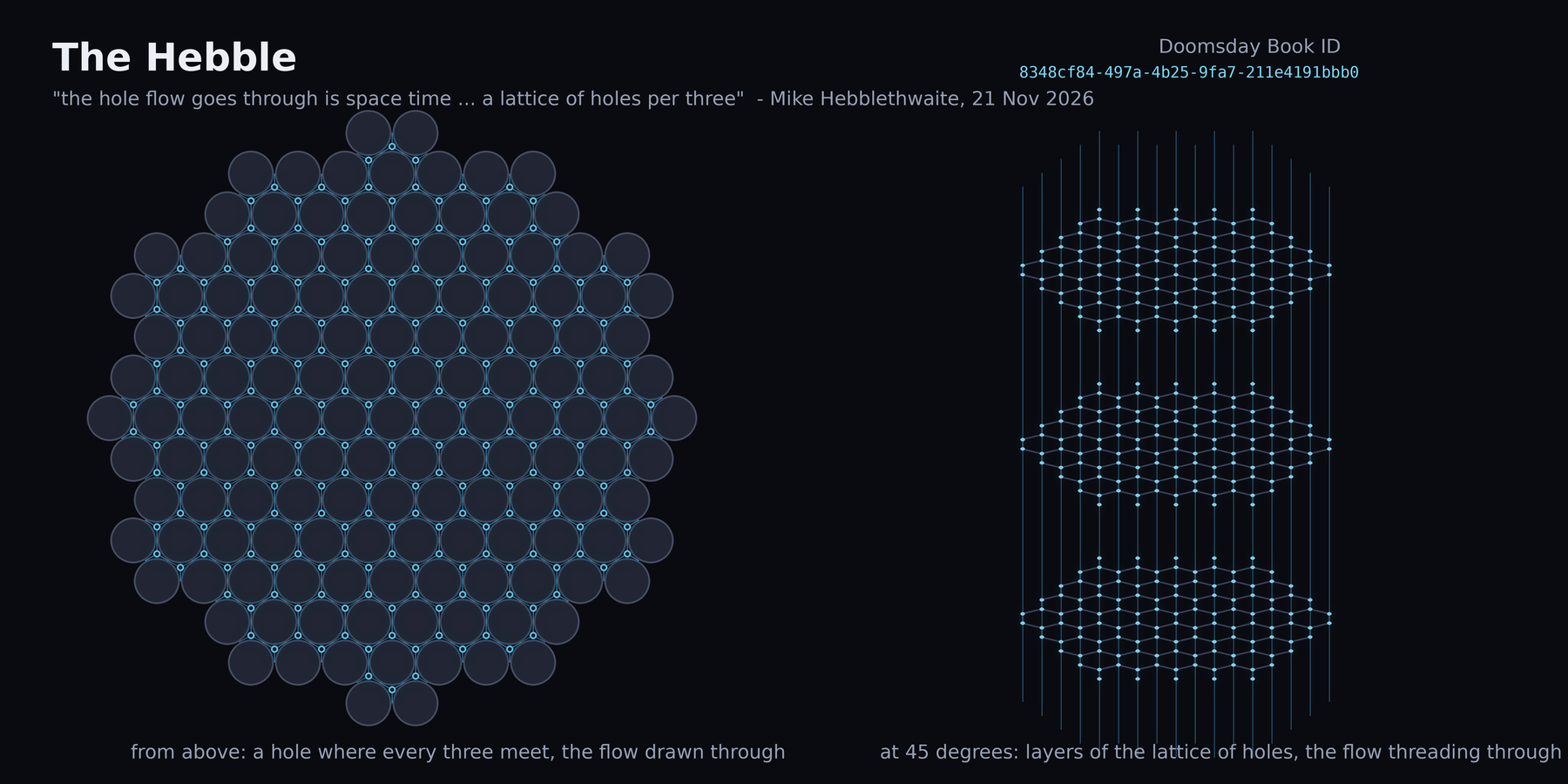
From above (left): things packed hex, six round one. Wherever three meet there is a hole, and the flow is drawn in from each gap between two, through the hole of their three. At 45 degrees (right): layers of that lattice of holes, with the flow threading through them.
Join the holes up and they make a honeycomb net: the shape of graphene’s sheet. The holes left between things packed hex make it by themselves. Stack the layers and the flow runs through the sheets.
This picture is the idea drawn by hand, not a run. Its Doomsday Book ID is
8348cf84-497a-4b25-9fa7-211e4191bbb0, written in the picture and in the file.
Where it came from: the raft
The author’s dream, told before the lab ran: ping pong balls, warm and pliable, pulled together by air flowing out through the gaps where three meet, go hex. The Delta lab built it: a cone tray of fine-holed plate, a Henry vacuum pulling under it, hot air from above. Balls set in hex by hand, as on the bench.
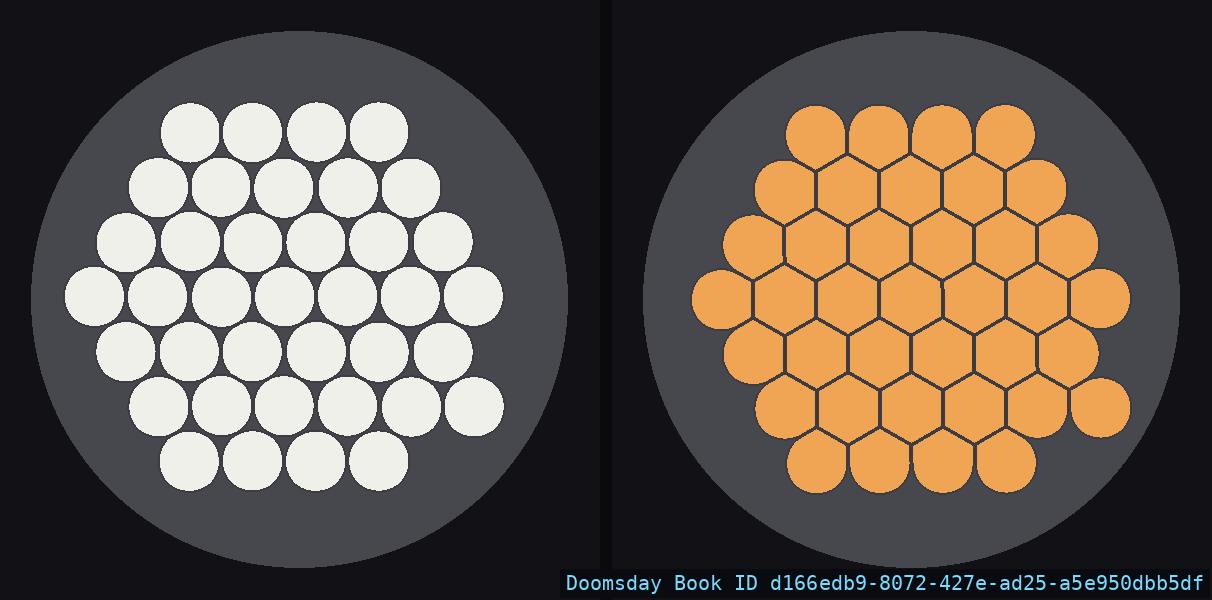
d166edb9-8072-427e-ad25-a5e950dbb5df, Mike J Hebblethwaite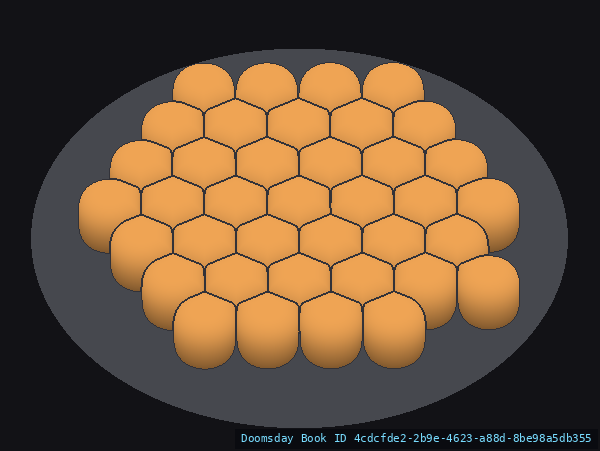
4cdcfde2-2b9e-4623-a88d-8be98a5db355, Mike J HebblethwaiteCold, the suction only locks them. Warm, each wall flattens against its neighbour as the flow pulls it into the gaps, and the raft closes. Warmth window: 81 to 98 C close the raft, none melting; 9D C melts every ball. A stronger Henry and finer plate holes close it sooner; the fastest: 69 seconds, holes 3 tenths of a mm, the Henry at full power, 93 C. (Numbers are D numerals: how to read them.)
0cc05e40-462f-4ec9-91b3-3e8c9f629d1f, Mike J HebblethwaiteEvery force the run works out, on every ball, each second (averaged over the second): white, the pull down the cone and the rim; cyan, the flow pulling it toward its neighbours; red, its neighbours pushing back where they touch; yellow, all of it together, which is what moves it. Inside the raft red and cyan nearly cancel; at the edge the flow pulls in and nothing pushes back from outside. Each ball’s weight is the same for all and is not drawn.
Mass from just light
The next step of the same idea: light is a wave, and side on we see nothing; where light from different ways crosses, a spin of three forms; they are forced to hex; the hole forms where three meet. The lab built it with no circle formulas at all: a sheet of hex cells, each wave passed from a cell to its six neighbours, step by step; light driven in along every other side of the sheet by weights on springs that swing by themselves (the swing is counted by the run, not worked out). Where the crossing light is brightest, mass forms: that one rule is put in, and marked as magic. Everything else below is measured.
“Let there be light”
Mike J Hebblethwaite, on first seeing this picture.
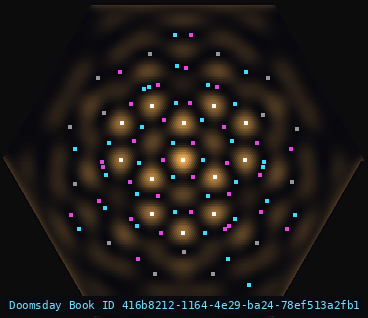
416b8212-1164-4e29-ba24-78ef513a2fb1, Mike J HebblethwaiteLight from three sides, a third of the way round from each other: the bright points sit six round one (hex), a little over 17 cells apart, the spacing the old maths gives for three crossing waves too (two thirds of a wave). One point in three is a little dimmer, as the light from the three sides is not quite equal. (Corrected: we first said a honeycomb. That came from counting only the points at least half as bright as the brightest, which left the dimmer third out. Counted down to a fifth as bright, every one has six round it. The picture shows the brightest.) Between them are dark still points, the holes (coloured). Round each hole the light’s peak comes round, one way (cyan) or the other (magenta): 23 one way, 23 the other, 3 not at all. The spins balance exactly. Light from two sides only (the control) gives stripes, few points and mostly no spin.
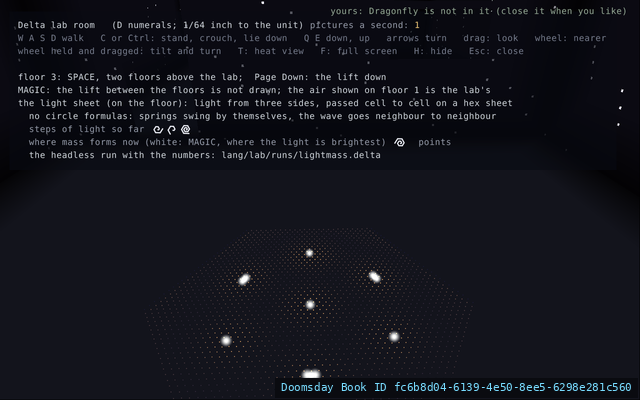
fc6b8d04-6139-4e50-8ee5-6298e281c560, Mike J HebblethwaiteThe same, live, in the Delta lab’s space room: two floors above the lab, reached by its lift. Black all round, the stars as points; on the floor the light sheet runs as you watch, light coming in from three sides, and the white glows are where mass forms: one in the middle, six round it.
What is put in, said plainly
In the raft runs the balls were set in hex by hand, and the rule for how fast a warm wall flattens is the lab’s own choice, marked as magic. The run keeps one flatness number per ball, and the pictures draw each face half way to a neighbour, so the hexagons follow from the hex start.
So a blind test was run. A fresh helper, never told the dream or any expected pattern, wrote the wall rule from materials alone (celluloid: sealed, with a hole, and splitting at its seam). The balls start scattered, every wall is its own, and hex is judged by numbers (the six-fold order round each ball), not by pictures. The plan and its pass mark were stamped in Bitcoin before any run. First finding: a sealed ball barely flattens, its heated air pushing back like a tyre; a vented or split ball flattens about a third of the way.
The hand-set raft with the real-material walls: its hex holds, but the walls flatten only 12% (sealed) to 38% (vented), none fully flat in 5 minutes at 120 C. So the raft does not seal in the lab with real celluloid; the warmth window and the times above came from the lab’s own flattening rule (magic). Sealing is still to be shown.
Sealed balls: FAIL. With the blind rule for sealed balls, scattered balls did not go hex: the six-fold order with heat and the Henry ended at 0.654 (it started at 0.659), below the pass mark of 0.7 and no better than cold balls (0.718). Sealed walls barely flatten (their heated air pushes back), so the balls stay round and jam where they land.
Vented balls (a hole in each, as in the dream): FAIL too. Their walls flatten about a quarter of the way and the hot run ended at 0.755, but it rose only 0.133 and the cold balls with the Henry did better (0.820, with 30 balls six round one). In these runs the order came from the Henry pulling the balls together, not from the heat. One run each varies by about 0.1, so the next tests use several runs.
A hand on the rig (the tray shaken, as Mike nudged his real rig): FAIL as stamped, and a finding. Shaken, the scattered balls packed hex whether cold or hot: 0.914 and 0.925, with 39 and 45 of 100 balls six round one. The heat added almost nothing to the order, so the pass mark (heat must beat cold by 0.2) is not met. What it shows: the shaking packs the balls hex; the heat flattens the walls of whatever pack there is. Packing and sealing are two steps.
And a fault under all of these: the lab’s COLD balls pack into hex (up to 30-41 of 100 six round one) where Mike’s real cold rigs never made hex. Every blind-test comparison above was made against those cold controls, so all of them rest on a faulty control. The lab’s cold balls must first behave as real ones do.
Repeated, five runs each: FAIL, and the finding above is withdrawn. Shaken balls averaged 0.762, still ones 0.780: shaking does not reliably pack them hex in the lab. One shaken run in five did (0.931); the single run above was such a lucky one. Said plainly too: some repeats took the same chance and ran alike, so the test was weaker than planned; it still does not support the shaking.
Source and proofs: github.com/mikehebblethwaite-hub/d-math
(lang/lab/runs/, proofs/blind-wall-2026-11-21/, the paper section 5.8).